

| AcquaStain Protein Gel Stain
Never Wash or Destain Again |
|||||||
 |
 |
|
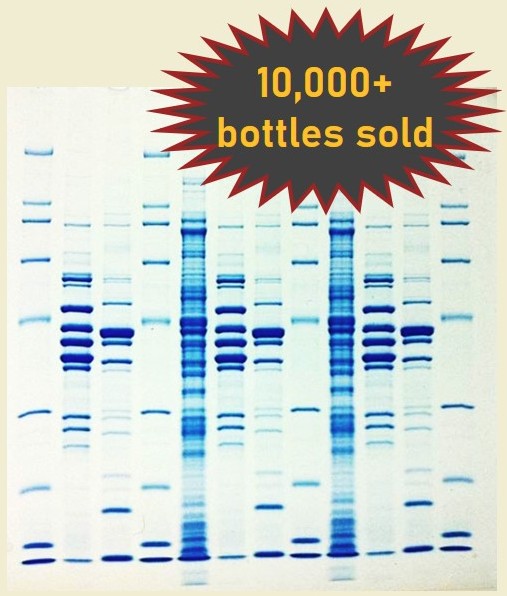
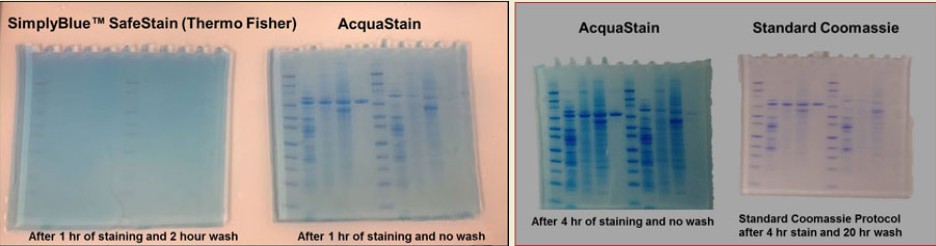
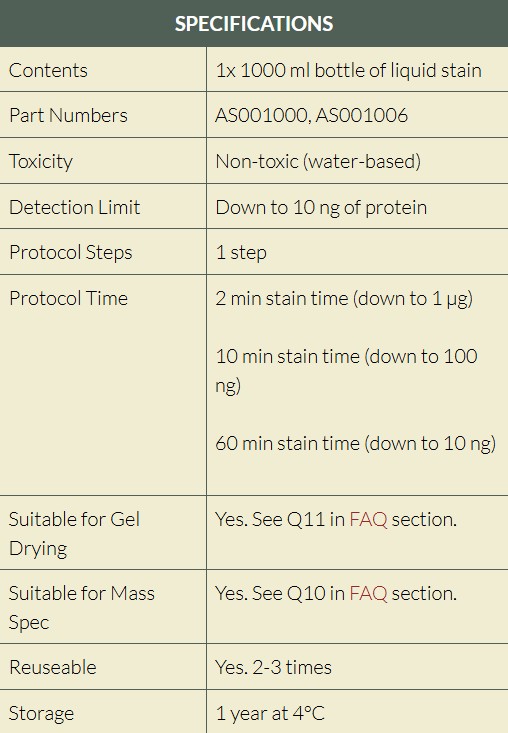
| Like Coomassie Blue only simpler AcquaStain is a single-step Coomassie Blue protein gel dye. This novel product doesn’t require pre- or post-treatment of the gel. Just run your protein gel, add the stain, and watch your bands appear in several seconds—no destaining required! AcquaStain also contains no harmful chemicals or acids, so it’s much safer than other dyes. It can even be disposed of in the sink after staining! Unlike many other stains, AcquaStain is a water-based product, which means that it causes no observable shrinkage or wrinkling of the gel. Better yet, unlike methanol-based stains, proteins isolated from AcquaStain treated gels are 100% compatible with mass spectrometry analysis. |
 |
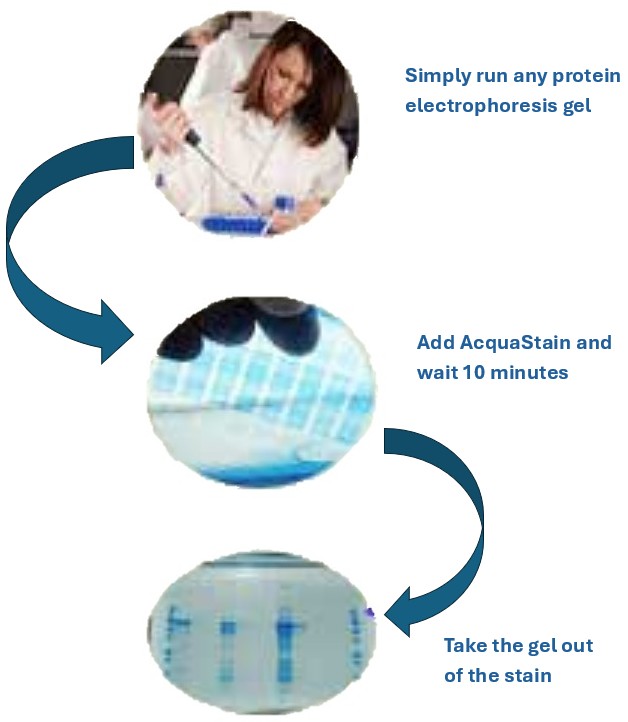
| One-step in 10 minutes Other “fast” gel staining technologies require expensive equipment or trade speed for reduced clarity of the protein bands. AcquaStain doesn’t. And no other “fast” product is as fast, either—the entire staining procedure can be completed in about 10 minutes (for typical protein amounts). Don’t worry, though; it’s impossible to over-saturate with this product, so you can safely incubate overnight with no harmful effects. Only AcquaStain provides a reasonably-priced reagent without the need for an external apparatus while delivering a super-sensitive signal—equivalent to or better than the best Coomassie-based reagents on the market. Protein bands really stand out, too, because the gel background remains crystal clear. AcquaStain is a teal color that’s totally free from precipitate. Shaking before use is not necessary. It’s like nothing you’ve tried before. |
 |
| Perfect for teaching labs With the capacity to run and stain protein gels during a typical one hour wet-lab class, this stain is right at home in the teaching lab. |
|
 |
WHAT CUSTOMERS SAY ABOUT ACQUASTAIN
“I am very happy with the AcquaStain … it does seem much more sensitive than my home made coomassie stain, with the additional benefit of no destaining.”
Sundeep, URMC, 2023
“AcquaStain is my go to protein stain for day to day use. The fact that it has low background staining makes staining gels a less painful experience.”
Jewett Lab, Northwestern University, 2022
“AcquaStain offered a much simpler workflow for staining our gels with improved contrast! We will happily convert our standard Coomassie stain / de-stain procedure to an AcquaStain procedure!”
Stephen, Biotech Company, 2022
“It works very nicely and it’s great that we don’t have to use methanol based destain … It really is a vast improvement in terms of time and waste.”
Martin, The Rockefeller University, 2019
“It works very well. It enabled some mass spectrometry experiments where we needed the sensitivity of silver staining but needed something compatible with mass spec. It was perfect for it.”
Chad, Ohio State University, 2017
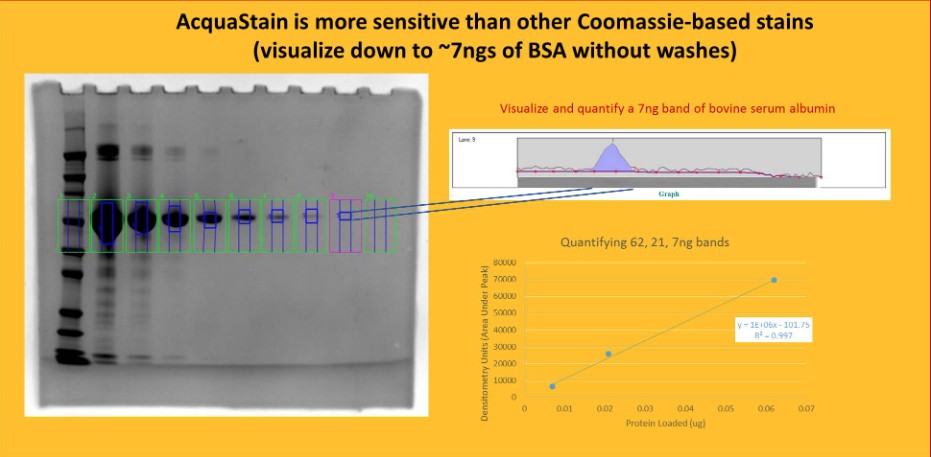
| Customer Data |
 |
 |
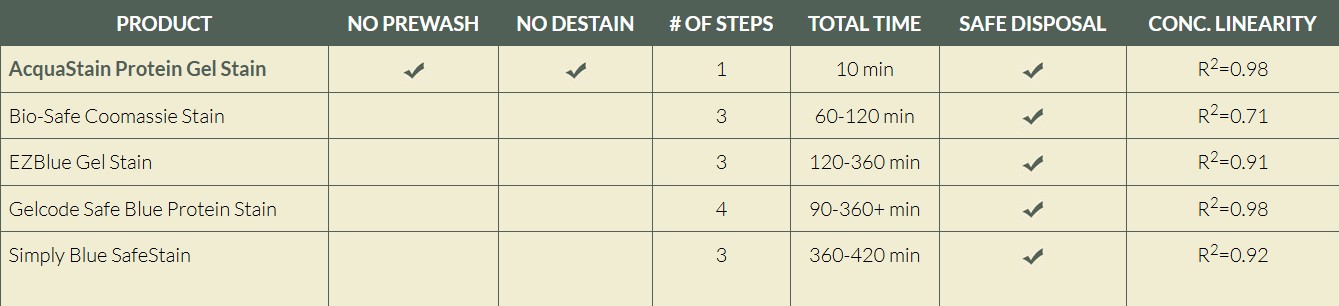
| Product Comparison |
 |
Additional information
PROTOCOL FOR MASS SPEC
1) Cut out protein band and place in microfuge tube
2) Add 1 ml 30% ethanol or 30% acetone (30% acetic acid may be used but will result in acetylation of N-terminus).
3) Incubate for 30 minutes.
4) Repeat steps 2 and 3 until all stain removed from protein (typically 2 or 3 washes are required for complete stain removal)
5) Process as typical for mass spec analysis.
HIGH AND STABLE SIGNAL
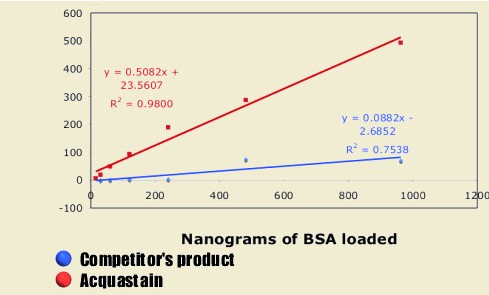 |
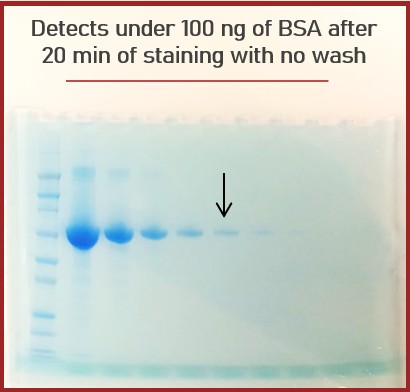
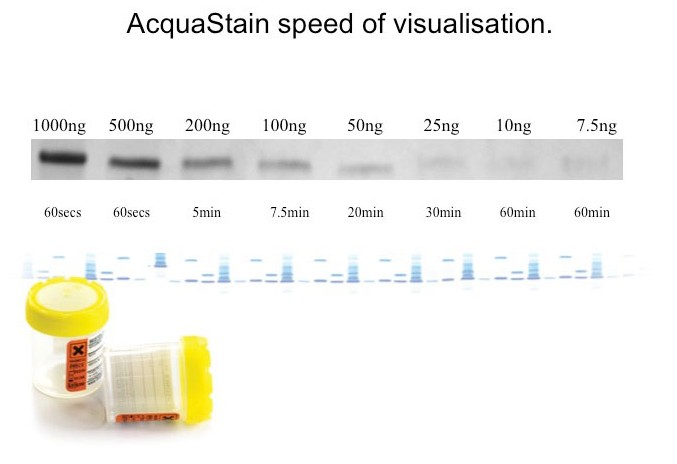
| AcquaStain will show greater signal even at low concentration of protein (60ng) within 10-15 minutes and down to 10ng (longer incubation). The signal generated by this stain is linear, enabling true quantitation of your sample. |
50 FOLD GREATER CONTRAST
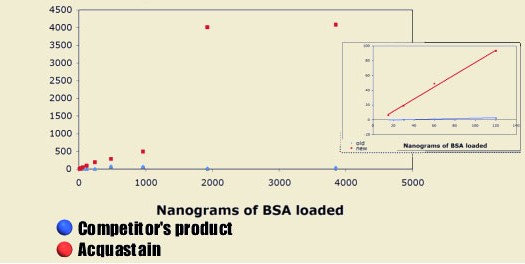 |
| AcquaStain shows a 50 fold greater signal when compared to a leading competitor |
 |
FAQ
Q1 – Why is it better to use AcquaStain at room temperature?
We recommend allowing AcquaStain to equilibrate to room temperature before staining. AcquaStain works much more quickly at warmer temperatures. In fact it can take 10x longer to visualize bands using cold AcquStain. Read A2/Q2 for more detail.
Q2 – What is the optimal temperature for staining gels?
For achieving the most effective staining, we recommend preheating the appropriate amount of AcquaStain (25ml for a mini-gel) to a temperature between 37°C and 42°C.
Q3 – What does Acqua Stain bind to?
Acqua Stain binds to basic amino acids in a similar way standard coomassie does, only much faster and more sensitive.
Q4 – Can I further decrease the time for staining?
Yes. By placing the gel in Acqua Stain and microwaving for 10-20 seconds, you can cut the times by roughly 50%.
Q5 – Can I increase the sensitivity/contrast on my Acqua Stain Gels?
Yes. If you gently agitate the gel in stain at 50°C during staining, you will see increased sensitivity. If you gently agitate the gel in heated deionized water (50-60°C) for 15-25 minutes post staining, you will see increased contrast.
Q6 – Why do the protein bands on my gel appear as blobs when I incubate overnight?
It is not possible to overstain however, Acqua Stain is more sensitive than traditional methods so it is quite possible that the gel was overloaded. In addition, low molecular weight proteins can diffuse over time if the gel isn’t fixed. We recommend decreasing the stain time to 60 minutes or less or loading less onto the gel.
Q7 – Does Acqua Stain fix the gel?
No. Acqua Stain is an aqueous-based stain and therefore will not fix your gel. After 30 minutes of incubation with the stain, the gels are very stable so there is no need to fix the proteins.
Q8 – After staining, can I store the gel in acetic acid?
Yes. You can store the gel in acetic acid or deionized water.
Q9 – Can Acqua Stain be used in colorimetric assays?
Yes. You can measure with a standard spectrophotometer or plate reader at 595nm
Q10 – What is the protocol for using proteins stained with Acqua Stain in mass spec analysis?
1) Cut out protein band and place in microfuge tube
2) Add 1 ml 30% ethanol or 30% acetone (30% acetic acid may be used but will result in acetylation of N-terminus).
3) Incubate for 30 minutes.
4) Repeat steps 2 and 3 until all stain removed from protein (typically 2 or 3 washes are required for complete stain removal)
5) Process as typical for mass spec analysis
Q11 – What is the protocol for drying down the gels after staining?
1) Ensure that the gel has been stained with Acqua Stain for at least 1 hour. Although protein bands will be visible after a few minutes of incubation in stain, the staining process is completely stable after 1h of incubation. Depending on the type of gel you are using longer incubation may be necessary. Further processing of the gel prior to completion of the staining process may result in protein destaining and reduced sensitivity. If this occurs simply restain the gel by incubating overnight in Acquastain.
2) Submerse the gel in approximately 100 ml ultrapure water at ~70°C (heat for 30s to 60s in a microwave oven). Incubate for at least 1 hour while gently rocking. Optionally adsorbent paper or paper towel can be added. Gels can be incubated overnight in water.
3) Incubate the gel in a ‘gel drying solution’ (e.g. 4% glycerol, 20% ethanol in water) for 2 minutes. Incubation of any Coomassie-stained gel in an alcohol solution will eventually result in destaining of the bands so avoid incubation for longer than 5 minutes.
4) The gel is now ready for drying between wetted cellophane membranes.
Q12 – Is AcquaStain compatible with a western blot?
Staining the gel with AcquaStain after transferring the proteins to a filter is a good method of determining transfer efficiency.
Q13 – Can AcquaStain be reused?
Yes. Typically, customers can use it two or three times.
Q14 – How do I dispose of AcquaStain after use?
AcquaStain is an acidic solution made with non-toxic chemicals (please refer to the SDS document). In some locations it can be poured directly down the drain. However, because AcquaStain is used with polyacrylamide gels, disposal should be done in accordance with your local laws and following the guidelines set forth by your lab or institution.
Q15 – Can AcquaStain be followed by traditional silver staining?
Yes. Please wash 3x with 50% ethanol for 15 minutes before proceeding with a standard silver staining protocol. Expected results shown:
