
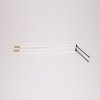
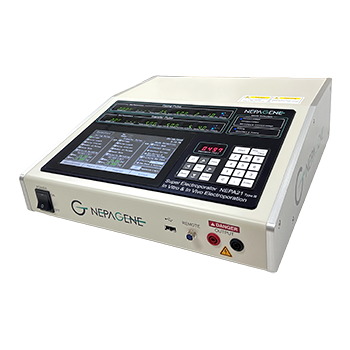
NEPA21 Type III
Advanced in vitro and in vivo electroporation with three electrical control modes,
automatic pre-pulse impedance checking and complete experimental traceability.
- Constant voltage, constant current and Set Current & Constant Voltage control
- Up to 500 V and 15 A output
- Automatic Ohm Check & Pulsing before delivery
- No mandatory proprietary buffer kits
For sensitive cells, tissues, embryos and in vivo targets
Research use only
More control over the electrical conditions that determine experimental outcome
Type III retains the proven NEPA21 poring-and-transfer pulse principle while adding
stronger control of voltage, current and impedance, better safeguards, and much more
complete programme and experiment management.
Control the variable that matters
Choose constant voltage, constant current, or Set Current & Constant Voltage mode
to match the electrical strategy to the sample and workflow.
- Programmable current and voltage limits on every mode
- Adjustable Target Voltage ceiling in Constant Current mode
- Delivered-energy monitoring for every pulse
Check the sample before pulsing
The integrated Ohm Check & Pulsing workflow measures sample impedance immediately
before pulse delivery and compares it with a user-defined acceptable range (0.000–99.99 kΩ).
- Identify conductivity variation before it wastes a sample
- Pulse output blocked automatically outside the accepted window
- Optional double foot switch: left pedal measures, right pedal pulses
Standardise and document
Store up to 300 named, date-stamped and lockable programmes, and retain the latest
100 pulse and impedance records even after power-off.
- Lock validated SOPs against accidental overwrite or deletion
- Faster troubleshooting from retained per-pulse voltage/current/energy data
- Export records via USB flash drive or the dedicated PC software
Separate poring from molecular transfer
Unlike a single undifferentiated pulse event, the NEPA21 sequence separates membrane
poration from payload movement. Voltage (or current) decay, multiple pulses and polarity
exchange can be configured independently to balance transfection efficiency and viability.
- 1
Poring pulseHigher voltage, shorter duration, up to 9 pulses with adjustable decay create temporary membrane pores with minimal damage.
- 2
Polarity-exchanged poringSupports tissue and adherent-cell workflows where directional access matters.
- 3
Transfer pulseLower voltage, longer duration, up to 99 pulses move DNA, RNA or other charged payloads into the cells.
- 4
Polarity-exchanged transferBidirectional transfer can further improve delivery across the target population.
Choose how electrical delivery is controlled
This is the central Type III advantage: the laboratory is no longer restricted to
constant-voltage operation when current or sample-impedance variation is the more
useful experimental consideration.
Constant Voltage
Preserves the established NEPA21 Type II operating approach — up to 500 V, with
programmable current limits. The logical starting mode when transferring an existing
Type II protocol to Type III.
Constant Current
Holds current as the controlled variable (up to 1.000 A per pulse step) while the
system adjusts voltage within a user-set Target Voltage ceiling — useful where sample
impedance changes between preparations.
Set Current & Constant Voltage
You select the target current; Type III measures sample impedance, uses Ohm’s law to
calculate the matching voltage (e.g. 0.1 A into 500 Ω calculates 50 V), then delivers
that value as a constant-voltage pulse.
This is different from true Constant Current mode: voltage is set once, before the
pulse, from the measured impedance — current is not actively regulated throughout
delivery. It lets you define a protocol in terms of current while keeping the
predictable, constant-voltage square-wave output labs are used to.
Set Current & Constant Voltage mode accounts for differences in starting sample
impedance — from buffer conductivity, sample volume, electrode contact or tissue
geometry — without changing the fundamentally constant-voltage nature of the delivered
pulse. It is not a substitute for protocol optimisation, and it does not by itself
guarantee higher transfection efficiency or viability; its value is more consistent,
better-documented electrical exposure across variable samples.
NEPA21 Type III versus NEPA21 Type II
Type III is a control, workflow and traceability upgrade built on the same core
NEPA21 electroporation principle.
The established NEPA21 platform—expanded for modern, multi-user research
Manufacturer terminology used throughout: the third mode is “Set Current & Constant Voltage”, not “constant power”.
| Specification | NEPA21 Type III | NEPA21 Type II |
|---|---|---|
| Pulse output modes | Constant Voltage; Constant Current; Set Current & Constant Voltage | Constant Voltage only |
| Maximum set voltage | 500 V | 300 V |
| Maximum output current | 15 A | 10 A |
| Pre-pulse impedance check | Automatic Ohm Check & Pulsing available | Manual impedance measurement; no integrated automatic check-and-pulse workflow |
| Impedance acceptance limits | Upper and lower limits: 0.000–99.99 kΩ | No programmable acceptance window |
| Constant-voltage current limit | Upper and lower limits: 0.000–15.00 A | Fixed selection: 2 A or 10 A |
| Constant-current voltage limit | Upper and lower limits: 0.0–200.0 V | Not applicable |
| Operation and display | Button keys plus LCD touchscreen | Button keys and 7-segment LED display |
| Programme storage | Up to 300 programmes with names, date/time, all settings and lock function | Up to 99 programmes containing electrical conditions; no lock function |
| Experiment history | Latest 100 pulse and impedance records retained after power-off | Last pulse and resistance record; erased after power-off |
| Data handling | USB Type-A, USB Type-B and dedicated PC software | RS-232C text output via terminal emulator |
| Optional foot control | Double foot switch (C220): impedance measurement and pulse output | Single foot switch (C200): pulse output only |
No proprietary kits — a real running-cost advantage
NEPA21 Type III does not require special reagents or disposable buffer kits. Comparing
the cost per electroporation session against two competing platforms shows the scale
of the saving over the life of the instrument.
NEPA21 Type III — per electroporation session
Competitor “N” (Company L) — per session
Competitor “N” (Company T) — per session
Figures as reported by Nepa Gene Co., Ltd. (March 2026). Many electroporators on the
market require expensive proprietary reagents or single-use kits — instrument cost is
only part of the budget picture, and daily running costs compound quickly across a
busy multi-user lab. Ask SONIDEL for the full cost breakdown for your protocol.
When does Type III create a meaningful advantage?
The value differs for a laboratory buying its first NEPA21 and a laboratory that
already has successful Type II protocols.
For a laboratory buying its first NEPA21
Type III is the preferred full-capability and future-proof configuration when the
device will support several users, sample types or research programmes.
- Core facilities and shared laboratories
- Primary, immune, stem and iPS cell workflows
- Organoids, tissues, embryos and in vivo targets
- New protocol development and optimisation
- Rare samples requiring electrical safeguards
- Teams needing locked SOPs and retrievable records
For a laboratory that already owns Type II
Type III is most compelling as an advanced development and quality-control platform,
rather than as a compulsory replacement for a reliable Type II.
- Variable impedance between sample preparations
- Need for constant-current protocol development
- Work requiring more than 300 V or 10 A headroom
- Multi-user programme control and audit history
- Expansion into high-value tissue, embryo or in vivo work
- A second instrument for throughput and continuity
Type III does not automatically improve every established Type II protocol.
Transfer existing SOPs first in Constant Voltage mode and validate biological
equivalence before formally replacing a validated method.
From cuvette transfection to in vivo gene delivery
Application-specific cuvettes, plate electrodes, tweezer electrodes, needle arrays and
specialist chambers extend the NEPA21 platform across in vitro, ex vivo and in vivo work,
with published, optimised conditions across a very wide range of primary cells and
established cell lines — from HeLa and CHO to primary T cells, iPS cells and mouse
embryonic fibroblasts.
Suspension cells
Primary cells, immune and blood cells, stem cells, iPS cells and established cell lines.
Adherent cells
Direct electroporation in compatible culture plates (CUY900 series) while cells remain attached — ideal for non-detachable cells like neurons.
Organoids
Dissociated clusters, whole organoids and related ex vivo three-dimensional tissue models, including validated knock-in/knock-out protocols.
CRISPR delivery
Plasmid DNA, mRNA and CRISPR/Cas-related payloads for knockout, knock-in and reporter workflows.
Zygotes and oviduct
TAKE, i-GONAD and rGONAD workflows using application-specific electrode configurations — 10–50 zygotes per session.
In utero and in ovo
Targeted delivery to embryonic tissues in mouse, rat and chick developmental studies.
In vivo tissues
Brain, retina, cornea, muscle, skin, liver, kidney and reproductive tissues, among others.
Ex vivo tissues
Brain slices, organ primordia, explants, islets, embryos and excised organs.
Algae and plant targets
Multi-pulse protocol development for algae with intact cell walls (Chlamydomonas, Phaeodactylum) and selected plant applications.
Electrodes, cuvettes and consumables
The NEPA21 Type III is compatible with the full existing NEPA/CUY electrode range, so a
lab moving up from Type II or CUY21 keeps its electrode investment.
EC-001/002/004 — 1 mm, 2 mm and 4 mm gap; 20–700 µl volume range
Sold with or without transfer pipettes
Connects to the voltage output for cuvette-based transfection
Also compatible with Bio-Rad and BTX cuvettes
Holds up to 20 cuvettes, any orientation
Transparent acrylic
Transfects DNA/RNA directly into adherent cells in multi-well plates
No detachment required
CUY560, CUY610P, CUY650P, CUY701P series and more
Muscle, embryo, chick and tissue-specific designs
C115CB / C115CB-2/-3, C117 hook & plug cable
1–3 m lengths
Single pedal — pulse output only
1.5 m, 2 m or 3 m cable
Left pedal: impedance measurement · Right pedal: pulse output
Type III exclusive
Trial the system with your own research model before purchase
SONIDEL supports the NEPA21 Type III with application-specific protocol guidance,
electrode selection and direct technical assistance throughout evaluation and adoption.
- FREE trial-before-purchase programme
- Application and protocol review before testing
- Live setup, training and troubleshooting by Teams or Zoom
- Access to the extensive NEPA electrode portfolio (250+ designs)
- Ongoing technical and after-sales support
NEPA21 Type III purchase and upgrade questions
Does Type III use a different electroporation principle from Type II?
voltage decay and polarity exchange. Type III adds electrical modes, higher output,
automatic pre-pulse impedance checking, programmable limits, a touchscreen and much
stronger record management.
Will a Type II protocol run on Type III?
compatible with legacy NEPA21, CUY21 and CUY21SC/Pro-Vitro applications. Begin by
recreating the protocol in Constant Voltage mode. As with any instrument change,
validate the transferred SOP using the laboratory’s normal viability and transfection
endpoints.
Does Type III guarantee higher transfection than Type II?
protocol-development flexibility, sample checking, safeguards, repeatability between
users and experimental traceability. Better biological performance may follow where
those controls resolve a real source of variation.
What is the benefit of the automatic impedance check?
concentration, electrode contact and tissue geometry. Type III can measure impedance
immediately before pulse delivery and compare it with a defined acceptable window
(0.000–99.99 kΩ), stopping pulse output automatically outside that range.
Does the system require proprietary electroporation buffers?
which is reflected in its running cost — reported at roughly USD 2.60 per session
versus USD 21–25 for some competing platforms. Appropriate media and buffers remain
application-dependent, and SONIDEL can advise from published and client-derived
starting protocols.
Can an existing Type II laboratory keep both instruments?
constant-voltage protocols and use Type III for method development, variable
impedance samples, sensitive high-value work and workflows requiring stronger data
traceability.
Is any special software needed to get data off the device?
and managing records on a PC uses the free NEPA21_Type3_PC_Software utility over a
USB cable, which mirrors the on-device Record Data screen.
The NEPA21 Type III is authorised for laboratory research use only and is not a
medical product. It has not been qualified or found safe and effective for human or
animal diagnostic or therapeutic application. Never touch electrodes, cables or the
voltage output sockets while a pulse is being delivered.
Evaluate NEPA21 Type III with your own samples
Discuss your workflow with SONIDEL and request a supported trial, electrode
recommendation, protocol review or formal quotation.
For research use only. Product specifications and appearance may change without notice.
Confirm final configuration, accessories and application compatibility with SONIDEL before ordering.