

TiYo LED Autofluorescence Quenching
 |
|
 |
LED Autofluorescence Quenching for CELL and TISSUE STAIN SIGNALS
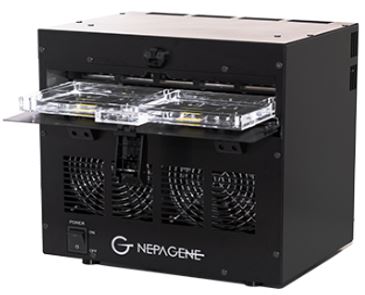
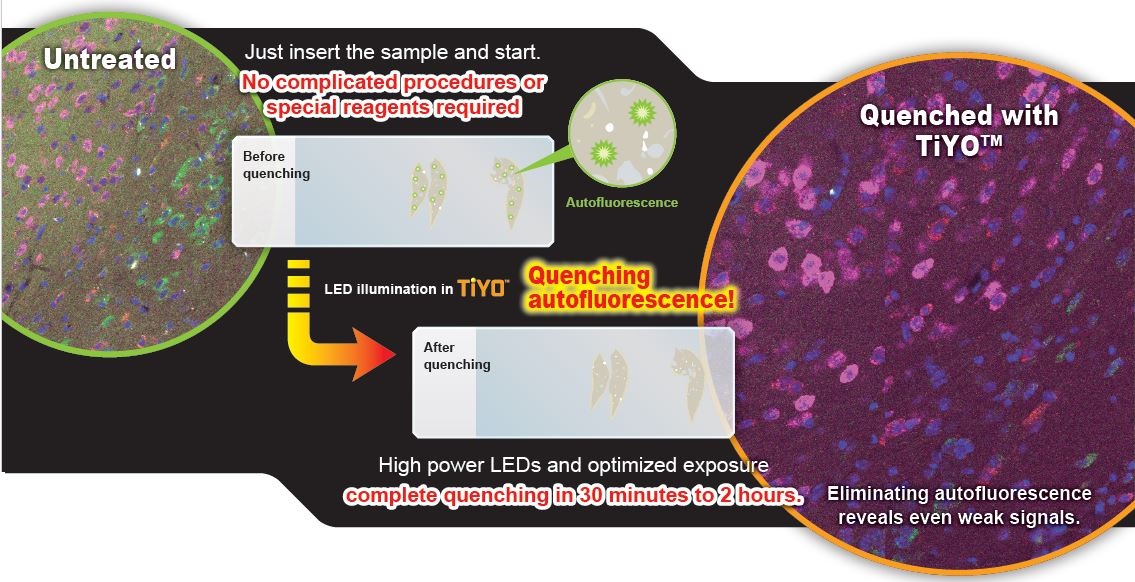
The TiYO™ is a wholly novel, first to market technology, that eliminates background autofluorescence signals in tissue stain signals. Noise in tissue observation is caused by substances not related to the staining label but which naturally emits autofluorescence. For example, lipofuscin granules, elastin fibers, vitamin A and other intrinsic molecules that accumulate in cells due to aging emit fluorescence. The autofluorescence generated by such substances present a problem for researchers because it is difficult to distinguish their auto-fluorescence signals from fluorescence signals artificially labeled by staining.
Advantages
- Eliminate background noise
- One Step Process
- No specialist reagents
- Lower running costs
- Minimal training required
- Maximise data from TISSUE sections
- Highly efficient
Features
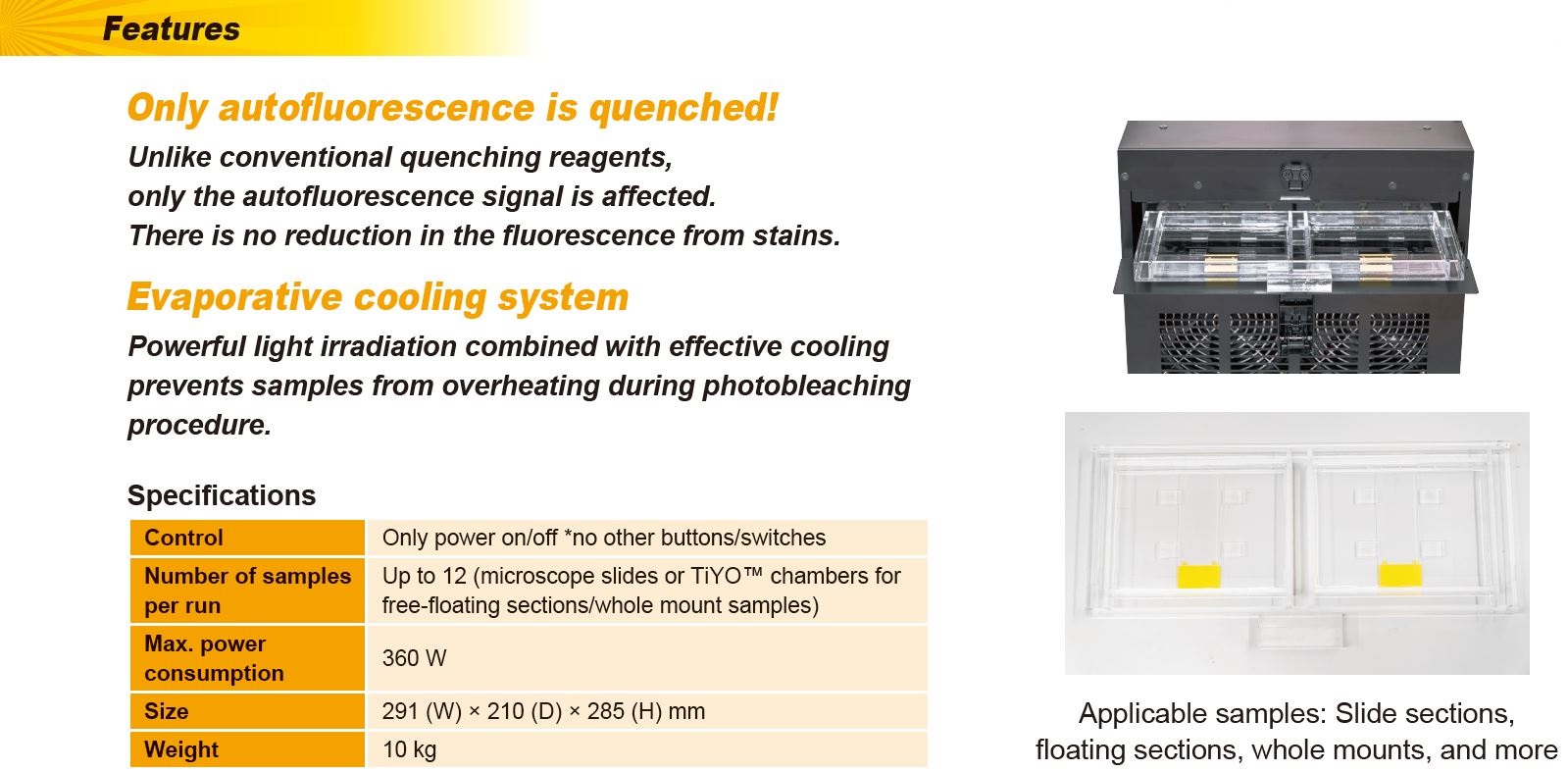
- EFFECTIVE for Highly Autofluorescent species
- ELIMINATE Autofluorescence for microscopy
- Display ONLY Fluorescence Staining
- Significantly LOWER running cost compared to the use of autofluorescence quenching reagents
- REVEAL weak stain signals HIDDEN by autofluorescence
- No REDUCTION in stain signal and minimum TISSUE DEGRADATION
- MAXIMISE data from TISSUE SECTIONS
- RE-STAIN a single glass slide MULTIPLE TIMES by TURNING OFF previously stained fluorescence
 |
How it works
TiYO™ combines an optimised light irradiation wavelength to photo-bleach unwanted autofluorescence and a novel cooling system that uses the heat of vaporization to remove heat from the surrounding tissue as water evaporates and thus, critically, prevents tissue degeneration due to overheating during the photobleaching procedure.
Compared to competing reagent-based quenching technologies, only the autofluorescence signal is quenched. There is NO REDUCTION in the fluorescence from stains.
One Step Process
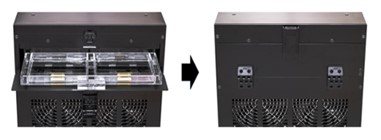
INSERT 1 – 12 samples in the tray and start quenching
 |
 |
| Comparative data for fluorescence staining Mouse Brain Sections Without treatment, with TiYO™ pretreatment, and with reagent treatment |
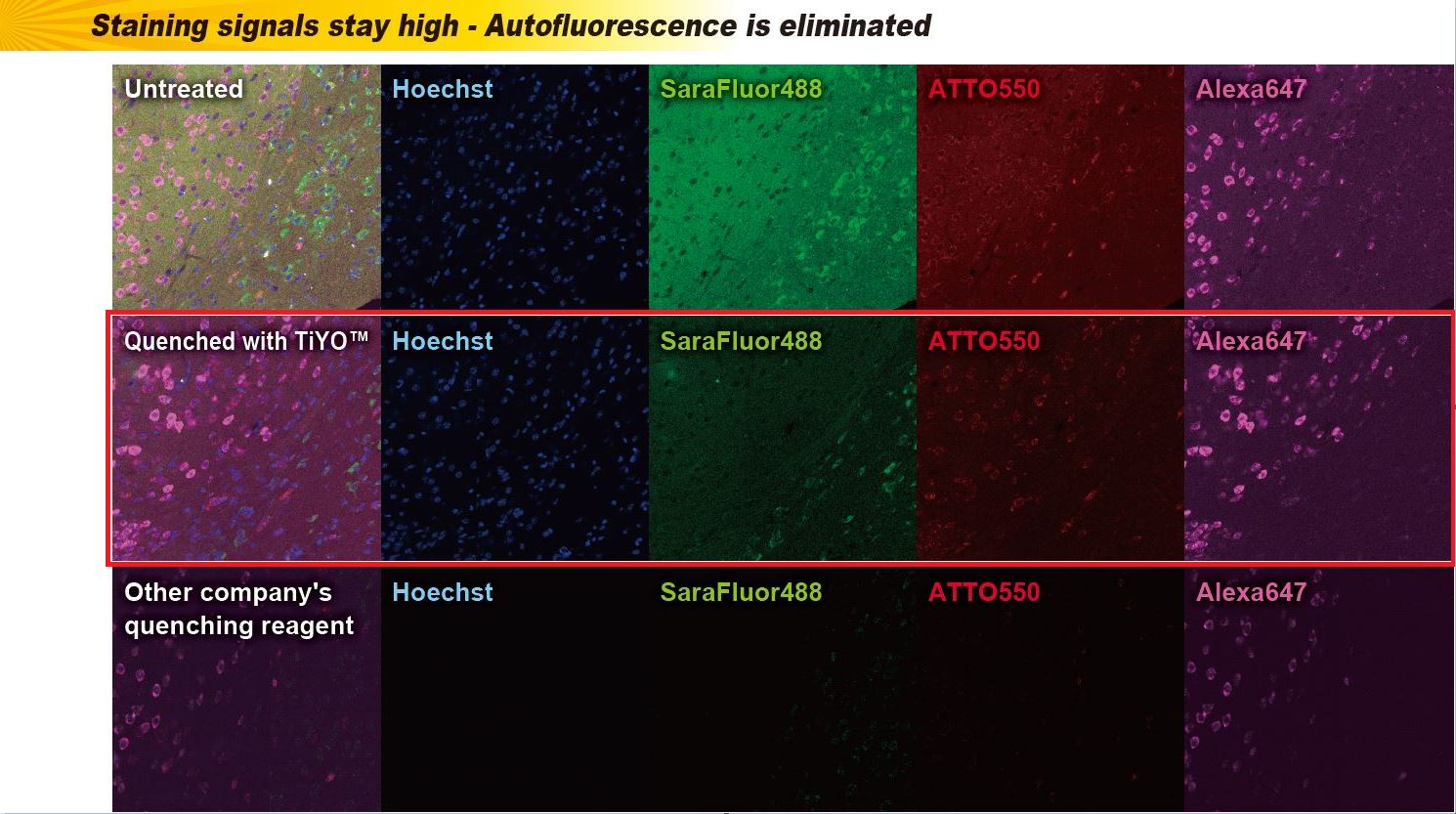 |
| The TiYO (Red box) has little effect on the fluorescence signal derived from stains. In comparison the quenching reagents noticeably reduce the intensity of fluorescence stains. |
| Reveal signals hidden by autofluorescence Mouse Brain sections |
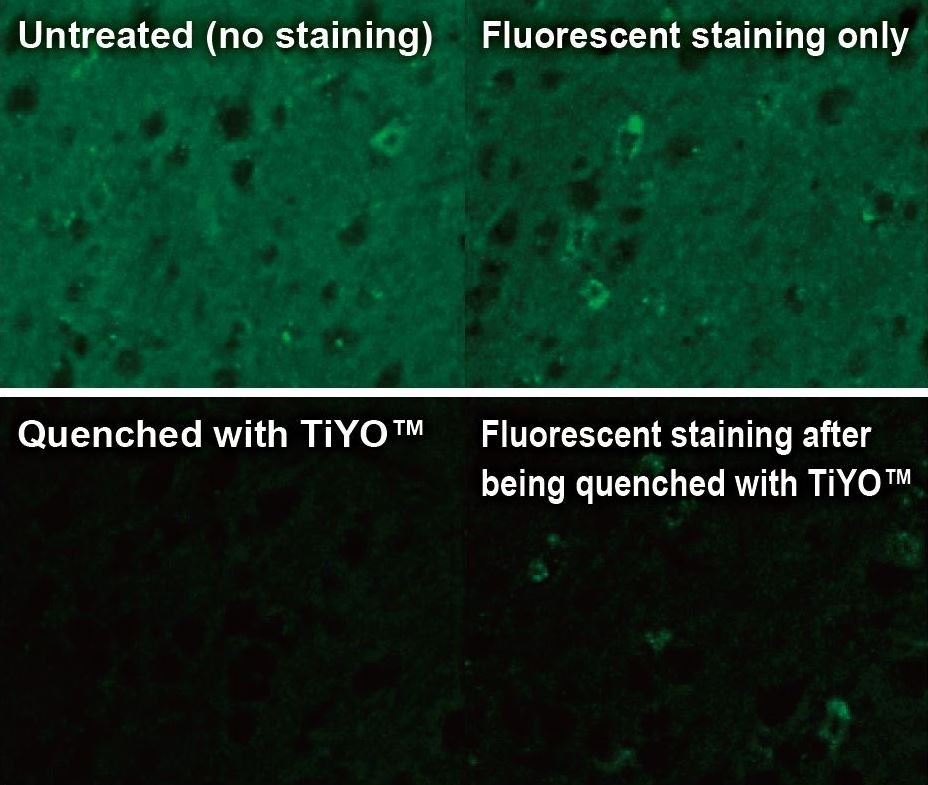 |
| Autofluorescence looks similar in both untreated and fluorescent staining panels above: this makes it difficult to distinguish true signals. True signals and hidden signals (concealed by noise) are REVEALED by staining tissues after quenching with TiYO. |
Effective for high autofluorescence tissue types
Chum salmon gill sections are known for their extraordinarily high levels of autofluorescence. A simple two-hour treatment with the TiYO eliminated the autofluorescence.
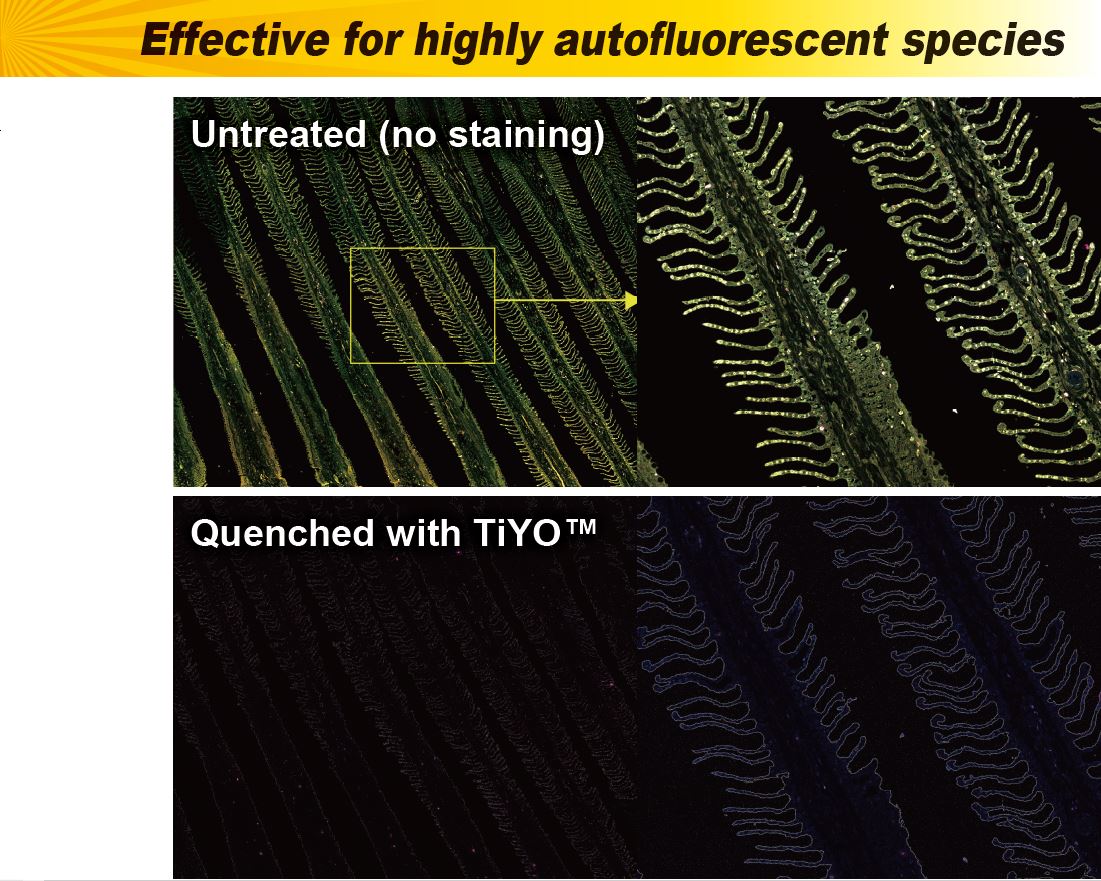
Autofluorescence of chum salmon gill sections and quenching with TiYO™. The same imaging conditions and contrast settings were used for all images (the outline of the tissue is outlined with translucent white lines).
Courtesy of Dr. Takehiro TSUKADA / Department of Biomolecular Science, Faculty of Science, Toho University
Reference: Fluorescence quenching by high-power LEDs for highly sensitive fluorescence in situ hybridization. Tsuneoka et al. (2022) Front Mol Neurosci
TiYO™ was jointly developed and commercialized using the technology invented by Associate Professor Yosuke Tsuneoka, Faculty of Medicine, Toho University (patent pending: JP-A 2021-008882).
*All features and specifications subject to change without notice.